POSTRELEASE of the IX Moscow International Financial and Economic Forum “Building Bridges, not Barriers. Business Eurasia in a New Reality”
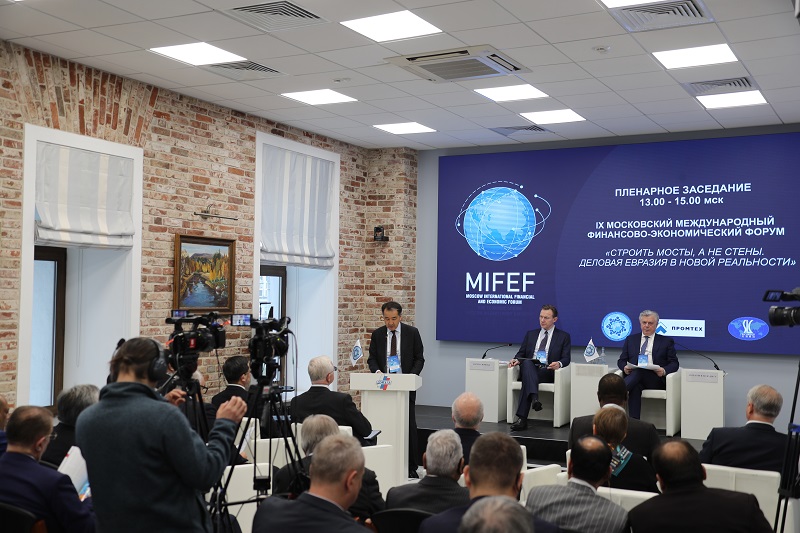
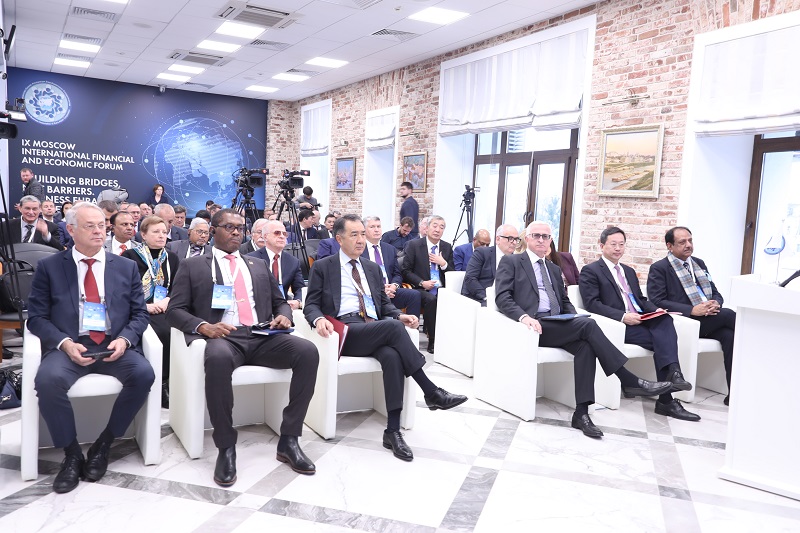
The plenary session of the IX Moscow International Financial and Economic Forum was held on November 24, 2022. In accordance with the current trends, it was held in a mixed mode – offline/online.
The Forum’s plenary session was preceded by the FBA EAC International Business Week, during which panel sessions were held in Moldova, Italy, and Russia.
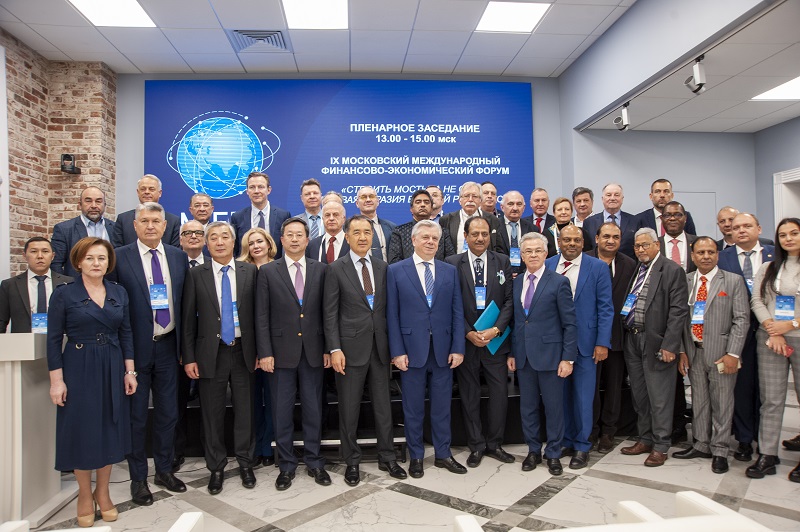
More than two thousand people from 36 countries of the world took part in the panel and plenary sessions of the Forum. The Forum was attended by representatives of the business communities of Italy, Kazakhstan, India, Syria, Russia, Germany, China, Senegal, the United Arab Emirates, Serbia, Kyrgyzstan, Greece, Moldova, Cyprus.
The top officials of the Eurasian Economic Commission, Russian Union of Industrialists and Entrepreneurs, International Congress of Industrialists and Entrepreneurs, Association of Financiers of Kazakhstan, Association of Banks of the Republic of Kazakhstan, Association of European Businesses, Moscow Chamber of Commerce and Industry, UNIDO Center for International Industrial Cooperation in the Russian Federation, UN Country Team in Russia, Union of Chinese Entrepreneurs of Russia, as well as the ambassadors and representatives of the Embassies of Brazil, Syria, and Kyrgyzstan also participated in the Forum.
The Forum was opened by Alexander Murychev, Chairman of the FBA EAC Board. On behalf of the organizers of the Forum, he welcomed the participants. Speaking about the history of the Forum, Alexander Murychev emphasized that over the past years the Forum has managed to acquire its own recognizable face and establish itself as an effective business platform, which over the past eight years has allowed to bring together more than five thousand representatives of business communities from 38 countries of Europe, Asia and Africa and discuss the most pressing issues of Eurasian integration.
Speaking about the specifics of the FBA EAC Forum, Alexander Murychev noted that the Forum focuses primarily on the business community of Greater Eurasia. The Forum’s panel sessions have long become productive platforms for exchanging opinions in professional communities, as well as for finding business partners, since their work has always been based on an industry principle.
Alexander Murychev thanked the official sponsors of the Forum, the Chinese company SLC-Rus and PROMTEX, whose help consisted not only in its financial support, but also in the contribution to the content of the Forum’s program.
Then Alexander Murychev read out greetings to the Forum participants from Deputy Prime Minister of the Republic of Armenia Mher Grigoryan and First Deputy Head of the Presidential Administration of the Republic of Kazakhstan Timur Suleimenov.
Li Shuobing, President of FBA EAC, addressed the participants of the Forum with a welcoming speech. In his address, he noted that, despite the current foreign policy situation, representatives from all over Eurasia, Africa, the East and even Latin America are taking part in the Forum, and this indicates, first of all, the relevance of the Financial and Business Association of Euro-Asian Cooperation. According to the President of FBA EAC, “the mutually respectful dialogue and constructive discussions that always accompany the work of our Forum prove that the mechanisms of “public diplomacy” are in demand today more than ever. While politicians are arguing and “flexing their muscles” without finding an opportunity to sit down at the negotiating table, entrepreneurs, as rational people who are able to take benefits and look for ways to increase them, are finding opportunities to negotiate and build cooperation bridges”. At the end of his speech, Li Shuobing expressed confidence that the intellectual results of the work of the Forum participants would certainly reflect goodwill and the desire for full-fledged cooperation. “After all, only together will we be able to overcome the crises and challenges posed by modernity to international business,” said the President of FBA EAC.
Traditionally, the Forum’s plenary session was moderated by Alexey Gromyko, Director of the Institute of Europe of the Russian Academy of Sciences, Corresponding Member of the Russian Academy of Sciences, who noted the extreme relevance of the Forum’s name and expressed regret that “the question of how to make people, countries, and businesses connect each other more than they currently do remains topical”.
At the plenary session, participants discussed a wide range of issues related to the impact of the relocation of development centers to the East on the global economy and foreign economic activity, problems of food and energy security, urgent tasks of combining the “One Belt, One Road” strategy and Eurasian economic integration in the new geopolitical environment, the state and prospects of cooperation between the EAEU and third countries (Asia, Africa, Latin America and the Middle East). The participants looked for answers to the questions “partners or competitors – who are the Eurasian economies in the context of global technological transformation?”, “can partnerships in Eurasia compensate for the weakening of traditional mechanisms of multilateral cooperation?”, “what tasks in the field of sustainable development does the Eurasian partnership help to solve?”, etc.
Bakhytjan Sagintayev, Member of the Board (Minister) for Economics and Financial Policy of the Eurasian Economic Commission, told the Forum participants about the efforts undertaken by the EEC to create a single economic space. Speaking about the Greater Eurasian Partnership, the Minister said that in the near future, in his opinion, it will consist of separate sub-regional blocks based on the common interest of the participants, their mutual technological, logistical, infrastructural and other mutually beneficial proposals.
In his speech, Rodrigo de Lima Baena Soares, Ambassador Extraordinary and Plenipotentiary of the Federative Republic of Brazil in the Russian Federation, focused on the theme of sustainable development that meets the needs of the present time without compromising the well-being of future generations. According to the Ambassador, the pandemic, interstate conflicts and their consequences, such as the food and energy crises, are the main challenges today. Brazil is ready to help the world community in solving these problems, because today it is one of the leaders in the production of “green” energy and food products.
Alexander Shokhin, President of the Russian Union of Industrialists and Entrepreneurs, Doctor of Economics and Professor, spoke about the need to resume constructive dialogue within the framework of international communities. If the platform of the G-20 summit in Indonesia turned out to be useful in bringing the position of the Russian business community to the partners, then to continue the dialogue in the field of trade and investment, it is necessary to use the WTO platform, which today has lost its role as a regulator of international trade, but, according to the President of RSPP, should restore this status. Alexander Shokhin also reminded the participants of the plenary session that the G-20 was created to effectively overcome economic crises and prevent them in the future, but today it does not cope with this task. The President of RSPP believes that it is necessary to create mechanisms within the framework of the G-20 for anti-crisis response, ensuring trade in essential goods – food and medicines. Besides, Alexander Shokhin stressed the importance of the existence of the Eurasian Economic Union. Among the main areas of its activity are project cooperation, the formation of a favorable business environment within the EAEU, as well as the development of a settlement system in national currencies, including digital currencies.
Rajneesh Goenka, Founder and Chairman of the MSME Development Forum, emphasized the role of small and medium-sized businesses in the economies of the world. Speaking about India, Rajneesh Goenka said that serious but still insufficient attention is being paid to the development and support of small and medium-sized businesses in his country. “I appeal to all Forum participants to support the development of the small and medium-sized business sector in their countries. This is the only way we will be able to overcome the current and all subsequent crises,” Rajneesh Goenka concluded.
Tadzio Schilling, CEO of the Association of European Businesses, focused on the problems of curtailing international cooperation. According to Tadzio Schilling, deglobalization is against economic logic, and this trend needs to be changed. “International cooperation is going through difficult times,” the speaker continued. “The large-scale tasks facing the states and companies of Eurasia must be solved in the context of reformatting traditional institutions of international trade and finance. Some of these institutions are currently paralyzed. The necessary solutions lie in strengthening regional integration, bringing national legislations closer together, and developing new financing tools”. At the end of his speech, Tadzio Schilling noted the important role of international business associations, which are able to guide the process of restoring old and establishing new business ties, and ensure the necessary dialogue between the business community and administrations at all levels.
Zhou Lijun, President of the Union of Chinese Entrepreneurs of Russia, introduced the participants to the figures reflecting the scale of cooperation between Russia and China. According to Zhou Lijun, the Union of Chinese Entrepreneurs of Russia comprises over 4,000 Chinese companies. “In 2022, amid the pandemic and sanctions, Chinese-Russian relations showed their resilience. This is especially true for trading. In the first 10 months of 2022, the bilateral trade turnover increased by 33% and reached $153 billion. By the end of the year, this figure will rise to a record $180 billion trade turnover,” said the President of the Union of Chinese Entrepreneurs of Russia. The speaker also paid attention to the problems related to logistics and bank settlements. “But the main thing is that Russia’s business is looking to the East, and China is looking to friendly Russia,” Zhou Lijun concluded.
Sergey Korotkov, Director of the UNIDO Center for International Industrial Cooperation in the Russian Federation, spoke about the development of cooperation within business associations and country unions. According to the speaker, the main opportunities for cooperation lie in the development of regional integration projects, such as the EAEU and the Eurasian Customs Union. China’s initiative “One Belt, One Road” not only improves the region’s ability to attract foreign investment, but also increases the competition between Russian and Chinese companies, as well as intensifies cooperation within the framework of BRICS+ in Central Asia.
William Fidel Souleymane Kwende, Managing Director of Africana Infrastructure Capital, Golden Organics Global, focused on the economic potential of African countries, which can become the basis for long-term cooperation between Russia and the countries of the African continent. “We have a long friendship that dates back to the time of the Soviet Union, when the USSR provided tremendous support to African countries, helping them gain independence, develop education, industry and agriculture, as well as train the first doctors and engineers who later built today’s Africa,” the speaker emphasized. “Africa consists of 54 countries covering an area of 30 million square kilometers. Africa has a large share of the world’s mineral resources. Today, it is the fastest growing economy, fueled by rising prices for consumer goods. Africa is one of the most dynamically developing places in the world in financial terms. A modern transport network is currently being built in Africa. There are ample opportunities for investment in development projects in Africa. African countries offer open mutually beneficial cooperation to the countries in other regions,” William Fidel Souleymane Kwende concluded.
Igor Tarciano Timo, Chairman of the Brazil-Russia parliamentary group, Member of the Chamber of Deputies of the National Congress of the Federative Republic of Brazil, focused on the issues of bilateral cooperation between Brazil and Russia. “In the new geopolitical conditions, our cooperation is playing an increasingly important role in the implementation of new projects leading to the strengthening of the economies of our countries. We pay great attention to financial cooperation. The Central Bank of Brazil attaches great importance to it. Cooperation has been developing successfully for a long time in the traditional areas such as trade in meat and other food products. Cooperation in the field of maritime and rail transport has also been developing successfully,” Igor Tarciano Timo noted in his speech.
The final speech at the Forum was made by Vladimir Kuznetsov, Director of the UN Information Center in Moscow, Chairman of the UN country team in Russia, noted that the topics raised by the Forum participants, in his opinion, are extremely important both for the global agenda and in terms of the efforts that the United Nations is making today. The plight of the world as a result of armed conflicts, climate change, global split, poverty and unemployment, mass migration of people, the effects of the global pandemic, etc. has led to a lack of funds to finance sustainable development. “Therefore, the most important thing that needs to be done today for the development of the global economy and the smooth functioning of financial markets is to restore lost trust,” Vladimir Kuznetsov concluded.
Summing up the discussion, Alexey Gromyko noted that the universal concern about the current situation of global split and distrust, as the speakers have repeatedly noted, should be overcome as a result of resuming dialogue, establishing cooperation between the world’s leading economies, and – in the context of the Forum – building new bridges to overcome the global economic crisis.
No less important than the discussion itself was the awarding of the winners of the competition for the International Public Award “Business Elite of Eurasia”, established in 2016 by FBA EAC and the International Banking Council. In the nomination “Standard of Stability”, the award was given to the Chinese company “SLC-Rus”. The Association of Financiers of Kazakhstan received the statuette in the nomination “Standard of Development”. The Italian company LEVORO became the “Standard of Reliability”, according to the Organizing Committee of the Award.
Also, in the final part of the Forum, a Memorandum of Cooperation was signed between FBA EAC and the Indian Association “Forum for the Development of Minor-Sized, Small and Medium-Sized Enterprises of India”. The Memorandum was signed by Oleg Berezovoy, General Director of the Association, on behalf of FBA EAC, and Rajneesh Goenka, Chairman and Founder of the MSME Development Forum, on behalf of the Indian Association.