
Back
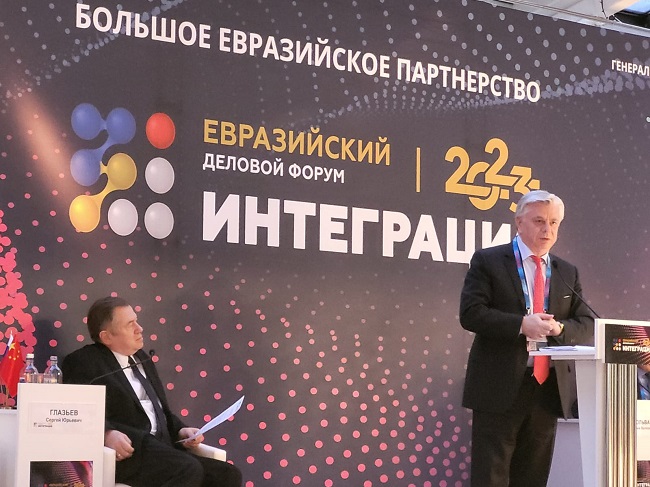
November 15, 2023, the Eurasian Business Forum “Integration” was held at Hotel President in Moscow. Representatives of federal and regional authorities, relevant structures, and the business community, together with the members of the Eurasian Economic Commission, discussed cooperation between the EAEU member states.
Among the main topics, there are practical results and new horizons of integration, the technological sovereignty of the EAEU, the formation of a unified system of technical regulation, the development of energetics and the sustainable functioning of the transport complex, as well as the identification of promising areas for Eurasian development.
The key event of the Forum was the plenary session “Great Eurasian Partnership. Advanced Development Strategy”, moderated by Sergey Glazyev, Member of the Board (Minister) for Integration and Macroeconomics of the Eurasian Economic Commission. In his speech, he said that the Commission, together with the countries of the Eurasian Economic Union, is currently actively working on a draft declaration on the further development of economic processes within the EAEU until 2030 and for the period up to 2045. Also, a report on the functioning of the EAEU is being prepared, which covers the entire period of the Union’s existence. Both documents are expected to be presented to the heads of the states in December.
Anton Shalaev, Head of Rosstandart, in his report at the plenary session, spoke about standardization as a driver of economic integration in the EAEU. He drew attention to the fact that significant experience in the application of standards has already been accumulated in the Eurasian space to ensure product safety and quality. First of all, it concerns the functioning of the technical regulation system, in which standardization is the foundation for managing product requirements – ensuring free movement in a single economic space.
Viktor Nazarenko, Minister for Technical Regulation of the EEC, said that the creation of a unified system of technical regulation of the EAEU has entered the final stage, when a return to the regulation at the national level is no longer possible. However, further progress is hindered by the tendency to preserve instruments of influence at the state level at the expense of integration opportunities.
Ms. Liu Qinghua, Minister-Counsellor of the Embassy of the People’s Republic of China in the Russian Federation, shared her views on the work on the integration of the Eurasian Economic Union and China’s “One Belt, One Road” initiative. “Integration and cooperation correspond to the course of historical development and reflect the interests of the countries,” she stressed.
Arzybek Kozhoshev, Member of the Board (Minister) for Energy and Infrastructure of the Eurasian Economic Commission, Dmitry Volvach, Deputy Minister of Economic Development of the Russian Federation, and many others took part in the discussion.
FBA EAC was represented at the event by Alexander Murychev, Chairman of the Association’s Board, Vice-President of the Russian Union of Industrialists and Entrepreneurs, who said in his speech that the program for financing industrial cooperation adopted in the EAEU is an important innovation for business, and expressed the hope that a large number of representatives of small and medium-sized businesses would be able to participate in the program.
The business program of the Forum included thematic sessions where the most pressing issues of Eurasian cooperation were discussed.
As before, the annual Eurasian Business Forum “Integration” contributed to the fulfillment of the most important task: maintaining a dialogue between government structures and business representatives to assist in expanding trade and economic contacts, entering new markets and finding new partners.
15 November, 2023
Eurasian Business Forum "Integration" was held on November 15, 2023 in Moscow
November 15, 2023, the Eurasian Business Forum “Integration” was held at Hotel President in Moscow. Representatives of federal and regional authorities, relevant structures, and the business community, together with the members of the Eurasian Economic Commission, discussed cooperation between the EAEU member states.
Among the main topics, there are practical results and new horizons of integration, the technological sovereignty of the EAEU, the formation of a unified system of technical regulation, the development of energetics and the sustainable functioning of the transport complex, as well as the identification of promising areas for Eurasian development.
The key event of the Forum was the plenary session “Great Eurasian Partnership. Advanced Development Strategy”, moderated by Sergey Glazyev, Member of the Board (Minister) for Integration and Macroeconomics of the Eurasian Economic Commission. In his speech, he said that the Commission, together with the countries of the Eurasian Economic Union, is currently actively working on a draft declaration on the further development of economic processes within the EAEU until 2030 and for the period up to 2045. Also, a report on the functioning of the EAEU is being prepared, which covers the entire period of the Union’s existence. Both documents are expected to be presented to the heads of the states in December.
Anton Shalaev, Head of Rosstandart, in his report at the plenary session, spoke about standardization as a driver of economic integration in the EAEU. He drew attention to the fact that significant experience in the application of standards has already been accumulated in the Eurasian space to ensure product safety and quality. First of all, it concerns the functioning of the technical regulation system, in which standardization is the foundation for managing product requirements – ensuring free movement in a single economic space.
Viktor Nazarenko, Minister for Technical Regulation of the EEC, said that the creation of a unified system of technical regulation of the EAEU has entered the final stage, when a return to the regulation at the national level is no longer possible. However, further progress is hindered by the tendency to preserve instruments of influence at the state level at the expense of integration opportunities.
Ms. Liu Qinghua, Minister-Counsellor of the Embassy of the People’s Republic of China in the Russian Federation, shared her views on the work on the integration of the Eurasian Economic Union and China’s “One Belt, One Road” initiative. “Integration and cooperation correspond to the course of historical development and reflect the interests of the countries,” she stressed.
Arzybek Kozhoshev, Member of the Board (Minister) for Energy and Infrastructure of the Eurasian Economic Commission, Dmitry Volvach, Deputy Minister of Economic Development of the Russian Federation, and many others took part in the discussion.
FBA EAC was represented at the event by Alexander Murychev, Chairman of the Association’s Board, Vice-President of the Russian Union of Industrialists and Entrepreneurs, who said in his speech that the program for financing industrial cooperation adopted in the EAEU is an important innovation for business, and expressed the hope that a large number of representatives of small and medium-sized businesses would be able to participate in the program.
The business program of the Forum included thematic sessions where the most pressing issues of Eurasian cooperation were discussed.
As before, the annual Eurasian Business Forum “Integration” contributed to the fulfillment of the most important task: maintaining a dialogue between government structures and business representatives to assist in expanding trade and economic contacts, entering new markets and finding new partners.
Membership
BECOME FBA EAC MEMBER
FBA EAC is a unique platform that represents and promotes the interests of its members through the support of their business activities in the countries of the Association's presence.
Feedback